
Private & Tailor-Made · Heritage-Led Journeys
Private Jewish Heritage Tours of Morocco
Jewish history in Morocco is not confined to a single museum or former quarter. It can be traced through the mellahs of Fes and Marrakech, restored synagogues and cemeteries, the port history of Essaouira, and communities whose stories form part of Morocco's wider cultural history. A private journey can follow that thread through the country, without losing the rest of Morocco along the way.
Quick Answer
A Jewish heritage tour of Morocco is a tailor-made itinerary built around the country's Jewish history — mellahs, synagogues, cemeteries, and museums — alongside the wider Moroccan experience of cities, food, architecture, and landscape. It suits travelers with Moroccan Jewish family roots, travelers interested in Sephardic and North African Jewish history generally, and travelers who simply want a more informed lens on Morocco. Nothing here is pulled from a fixed brochure: the route, pace, and heritage emphasis are shaped around what actually interests you.
Why It Matters
Why Jewish Heritage in Morocco Matters
Jewish communities have lived in Morocco for roughly two thousand years — among the oldest continuous Jewish presences anywhere, predating the Arab conquest of the region by centuries. Their history includes long periods of indigenous settlement, the arrival of Sephardic refugees expelled from Spain and Portugal in 1492 and 1496, and centuries of trade, scholarship, craft, and religious life woven into Moroccan cities.
That history is not a simple story of untroubled coexistence. Jewish communities in Morocco lived under a legal status with defined protections and defined restrictions, were periodically subject to violence, taxation, and confinement to walled quarters, and also built centuries of genuine intellectual, commercial, and cultural life alongside their Muslim neighbors. Both things are true, and a serious heritage journey holds both.
At its 20th-century peak, Morocco's Jewish population reached roughly 250,000 to 350,000 people — the largest Jewish community in the Arab world, according to Wikipedia's sourced account of Moroccan Jewish history. Following the establishment of Israel in 1948 and further waves of emigration through the 1960s and 1970s, the great majority of that community left for Israel, France, and North America. Today, the Jewish Virtual Library — a project of the American-Israeli Cooperative Enterprise — reports that "the Jewish population of Morocco stands at approximately 2,500 people," the great majority in Casablanca. What remains to visit is largely physical heritage: buildings, cemeteries, and museums maintained as historical and cultural sites rather than as the center of active daily community life.
What You Can Experience
What You Can Experience on a Jewish Heritage Journey
Historic Mellahs
The walled Jewish quarters of Fes, Marrakech, and other cities — the physical framework Jewish community life was organized around for roughly five centuries.
Synagogues
From restored historic buildings now open as heritage sites to active synagogues that still hold services in Casablanca.
Jewish Cemeteries
Sites such as Marrakech's Miaara cemetery and Essaouira's Jewish cemeteries, maintained by local caretakers and, for some travelers, sites of pilgrimage.
Museums
The Museum of Moroccan Judaism in Casablanca and Essaouira's Bayt Dakira document Jewish-Moroccan life through objects, photographs, and reconstructed interiors.
Architecture & Neighborhoods
Distinctive mellah architecture — balconied façades, wrought-iron railings — still visible in the urban fabric of several cities.
Family & Community History
For travelers with Moroccan Jewish ancestry, the chance to see a family's town, mellah, or community of origin firsthand.
Start Planning
Design Your Tailor-Made Jewish Heritage Journey
Share your dates, your heritage interests, and any family connection to Morocco, and Ismail and Mustapha will shape a private route around exactly that. A few helpful things to include: your approximate travel dates, number of travelers, trip length, which cities or themes matter most, any known family town or community, Sahara interest, accommodation style, and dietary or Shabbat requirements.
Prefer to talk it through directly? Message Ismail and Mustapha on WhatsApp and they'll reply personally, usually within minutes.
Casablanca
Jewish Heritage in Casablanca
Casablanca is more than the usual arrival airport — it's home to the great majority of Morocco's remaining Jewish community and its most significant Jewish museum. The Museum of Moroccan Judaism, established in 1997 in a former Jewish orphanage building, is what Lonely Planet describes as "the only Jewish museum in the Arabic-speaking world," tracing roughly two thousand years of Jewish life in Morocco through clothing, ritual objects, and a reconstructed 1930s synagogue from Larache. The museum was reopened after renovation in a 2016 ceremony attended by King Mohammed VI.

Museum of Moroccan Judaism
Located in the Oasis neighborhood, a former Jewish orphanage building repurposed as a museum in 1997. We confirm current hours and any group-visit requirements as part of planning your itinerary.
Casablanca's Jewish Community
Home to the majority of Morocco's remaining Jewish residents, along with active synagogues and communal institutions. Service and visitor access is arranged for your specific travel dates.
Fes
Jewish Heritage in Fes
The Mellah of Fes is Morocco's oldest, established in 1438 when the city's Jewish community was relocated to a new fortified quarter beside the royal palace — the origin point for the word "mellah" as it's used across Moroccan cities today. Fes went on to host the largest Jewish community in the country for centuries.
Within the mellah, the Ibn Danan Synagogue, built in the 17th century by the Ibn Danan family, is one of the district's oldest surviving buildings and today functions as a place of worship as well as a heritage site; it was formally restored and reopened in 1999, and again more recently. A short walk away, the Slat Al Fassiyine Synagogue is reputed to be the oldest synagogue in the mellah. It ceased to function in 1970 and was restored and reopened in 2013. Both are part of a wider restoration program — alongside the Mansano and Imhabanin synagogues — covering the mellah's four historic synagogues.

Ibn Danan Synagogue
17th century. Located within the Fes Mellah, with a terrace overlooking the old Jewish cemetery. Included as a walking stop on most Fes heritage routes.
Slat Al Fassiyine Synagogue
Reputed to be the oldest in the mellah; restored and reopened in 2013 after decades of disuse. A short walk from Ibn Danan, easily paired on the same visit.
The mellah and its synagogues sit within walking distance of each other inside Fes el-Jdid. A private guide can walk this route at whatever pace suits you, without needing to consult a fixed group schedule.
Marrakech
Jewish Heritage in Marrakech
The Mellah of Marrakesh, the second-oldest in Morocco, dates to the mid-16th century. At its 1940s peak it held tens of thousands of residents; today it is a working, largely Muslim neighborhood that still carries the physical imprint of that history in its street plan and architecture.
The Lazama Synagogue — named for Jewish exiles from Spain, whose first synagogue on this site dates to 1492, with the current building from around the turn of the 20th century — remains open to visitors most days and holds services on Shabbat. A short walk away, the Miaara Jewish Cemetery is one of the largest in Morocco, with graves reportedly dating back roughly five hundred years, maintained today by local caretakers.

Lazama Synagogue
Marrakech's best-known synagogue, in the historic Mellah, with a distinctive blue-and-white tiled courtyard. Modest dress is expected, as at any active place of worship.
Miaara Jewish Cemetery
One of Morocco's largest Jewish cemeteries, a short walk from the Lazama Synagogue. A kippah is provided at the entrance for those who'd like one.
Essaouira
Jewish Heritage in Essaouira
Essaouira — known historically as Mogador — has an unusual Jewish history among Moroccan cities: it was built largely from scratch in the 18th century as a planned Atlantic trading port, and the sultan specifically recruited Jewish merchant families to help run its international commerce. At points in the 19th and 20th centuries, Jewish residents made up a substantial share of the city's population, an unusual distinction in the Muslim-majority world at the time.
Bayt Dakira ("House of Memory"), inaugurated in January 2020, is a museum and research center housed in the restored Simon Attias Synagogue, documenting the city's Jewish-Muslim commercial and cultural history. At the inauguration, Essaouira-born Chief Rabbi David Pinto was quoted by Middle East Online saying: "if we are here today it's because of King Mohammed VI."
The city is also a pilgrimage destination associated with Rabbi Haim Pinto (1748–1845), the city's leading rabbi, whose grave in Essaouira's old Jewish cemetery draws visitors annually around the anniversary of his death, a tradition known as a hiloula. In May 2025, Essaouira's last known Jewish resident, Joseph Sebag, passed away — a reminder that the city's living Jewish community, once central to its identity, no longer exists in the form it once did, even as its physical and cultural heritage is actively preserved.
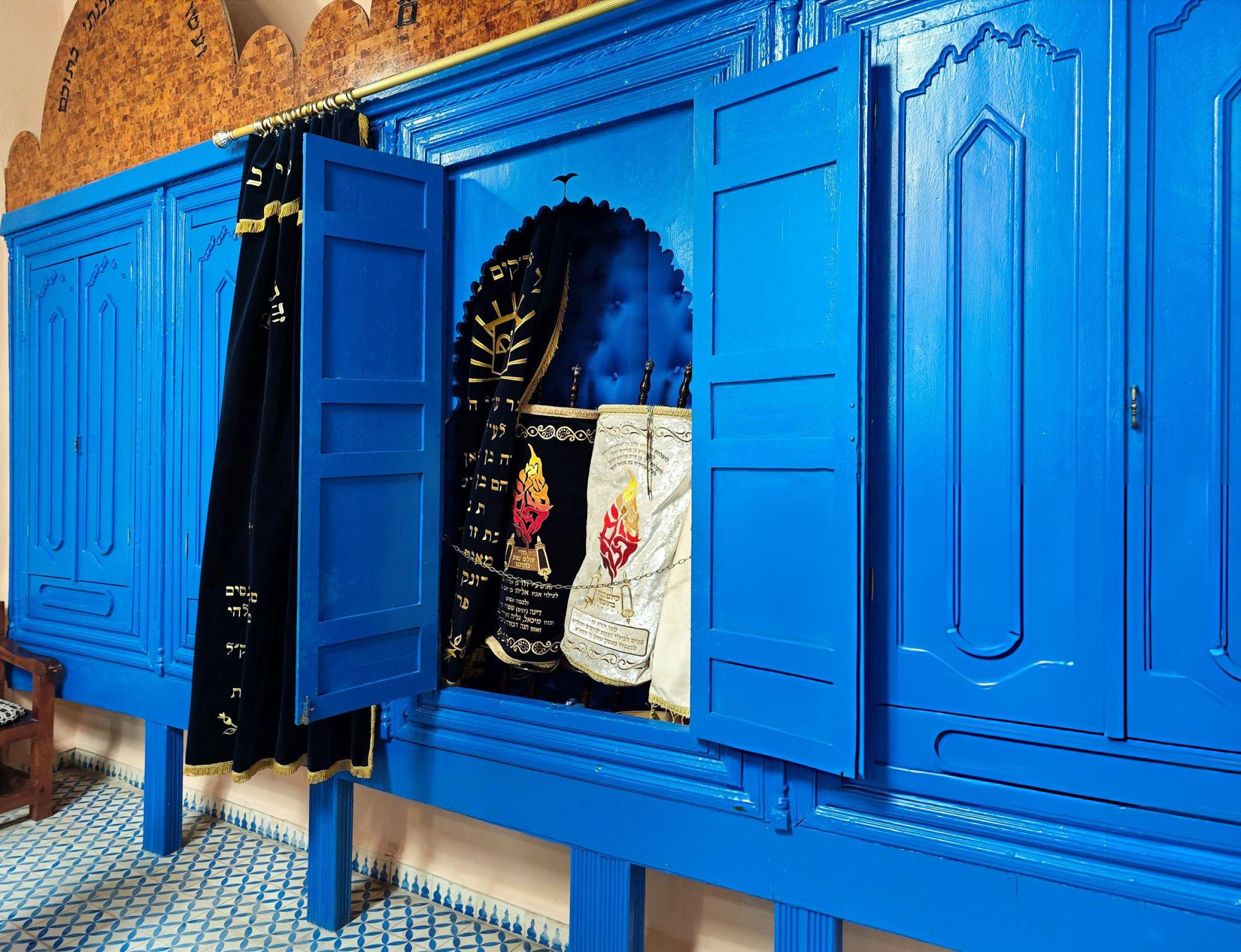
Bayt Dakira
Museum and research center in the restored Simon Attias Synagogue, in the historic mellah. A natural anchor for a half-day exploring Essaouira's Jewish history.
Rabbi Haim Pinto Sites
Synagogue and grave associated with the 18th–19th century rabbi; an active pilgrimage destination during the annual hiloula each September, and quietly accessible the rest of the year.
South of the Atlas
Jewish Heritage in Southern Morocco
South of the Atlas Mountains, Jewish settlement followed a different pattern than the walled urban mellahs of Fes or Marrakech. Wikipedia's entry on the mellah describes what it calls the rural mellah — "a relatively isolated open village inhabited exclusively by Jews," historically found across the Atlas, the Rif, and the desert-edge plains reaching toward the Sahara. In the Draa Valley specifically, Jewish communities are documented from at least the 11th century, working largely as silversmiths, money-changers, and long-distance traders along the trans-Saharan caravan routes that ran through this region.
The clearest place to see this today is Amezrou, a village on the edge of Zagora that grew up around exactly that trade. Its mellah — a distinct quarter within the village, its mudbrick houses still marked by carved Stars of David above the doorways — was once home to a substantial community of Jewish silversmiths. The community left for Israel, France, and Canada mostly between 1956 and 1967; the Berber families who moved into the same houses left the carved stars in place, regarded locally as protective symbols rather than a marker to remove. Amezrou's small synagogue has been restored, and silver workshops in the old mellah are still active, continuing a craft the community here was known for. Amezrou sits directly on the route toward Erg Chigaga, and pairs naturally with a private desert itinerary such as our Erg Chigaga & Essaouira Desert Tour.

Further east, Tinghir — a Berber oasis town at the edge of the Sahara — had a substantial Jewish community until the mid-20th century; none remain today. Its mellah gate and the layout of the old Jewish quarter are still visible, and the town's Jewish history is the subject of Tinghir-Jerusalem: Echoes from the Mellah, a documentary by French-Moroccan filmmaker Kamal Hachkar tracing his own grandparents' Amazigh-Jewish community.
Local tradition in the Draa Valley points to an even older site: Tidri (recorded in some sources as Taourirt N'Tidri), near Mhamid at the valley's southern end. Regional oral history and Hebrew manuscript traditions describe it as the oldest Jewish settlement in Morocco, with accounts of Jewish arrival by camel caravan and a semi-legendary "Jewish kingdom of the Drâa" centered nearby. These traditions sit closer to regional oral history than to verified archaeology, and the site itself lies in a restricted area near the Algerian border that isn't generally open to visitors — we mention it here for its place in the region's story, not as a stop we can currently include on an itinerary.
Amezrou Mellah & Silversmiths
Restored synagogue, carved Stars of David on former Jewish houses, and active silver workshops, on the edge of Zagora.
Tinghir's Former Mellah
A visible mellah gate and quarter, subject of the documentary Tinghir-Jerusalem, with no remaining Jewish community.
Further Afield
Beyond the Major Cities
Casablanca, Fes, Marrakech, and Essaouira hold the country's most substantial and visitor-ready Jewish heritage sites, but they aren't the only cities with meaningful history. Meknes, Rabat, and Tangier each had established Jewish communities and mellahs of their own; Sefrou, a small city near Fes, was historically home to a significant Jewish population relative to its size. These can add genuine depth to a longer, more regionally exploratory itinerary, and we're happy to talk through what's realistically worth including for your route.
| City | Jewish Heritage | Why Visit |
|---|---|---|
| Casablanca | Museum of Moroccan Judaism; largest remaining Jewish community | The country's only dedicated Jewish museum, and the center of contemporary Jewish life in Morocco |
| Fes | Oldest Mellah (1438); Ibn Danan & Slat Al Fassiyine synagogues | The historical origin point of the mellah system and its oldest surviving synagogues |
| Marrakech | Lazama Synagogue; Miaara Jewish Cemetery | An active synagogue and one of Morocco's largest historic Jewish cemeteries |
| Essaouira | Bayt Dakira; Rabbi Haim Pinto sites; Jewish cemeteries | A city literally built with Jewish merchant participation, with an unusually documented Jewish-Muslim commercial history |
| Southern Morocco (Draa Valley) | Amezrou's mellah & silversmiths; Tinghir's former mellah; the legendary site of Tidri | A different, rural pattern of Jewish heritage, often paired naturally with a Sahara route |
| Meknes, Rabat, Tangier, Sefrou | Historic mellahs and communities of varying preservation | Added depth for longer, slower-paced itineraries — best assessed case by case |
A Quick Definition
What Is a Mellah?
A mellah is the historic Jewish quarter of a Moroccan city — typically walled, gated, and located near the royal palace or governor's residence. The first was established in Fes in 1438; the practice spread to other cities including Marrakech, which followed in the mid-16th century. The name is Arabic for "salt," though historians disagree on exactly why.
According to Wikipedia's sourced entry on the mellah, the term likely originated as a local place name for a salt-producing area near Fes, and "originally had no negative connotation but was rather just a local toponym." Popular legends later attached darker explanations to the word — including a claim that Jewish residents were made to salt the severed heads of executed rebels for public display — but historians treat these as folk etymology rather than documented fact.
Mellahs functioned differently from European ghettos: residents were under direct royal or gubernatorial protection, retained internal communal autonomy, and the quarters were often located for administrative and security reasons as much as separation. That said, conditions varied significantly by era and city, and mellahs could also become overcrowded and impoverished, particularly from the 19th century onward. What travelers see today is largely the physical shell of that history — distinctive balconied architecture, narrow lanes, and, in Fes and Marrakech, the synagogues and cemeteries that anchored community life for centuries.
Sephardic Heritage
Sephardic Jewish Heritage in Morocco
"Sephardic" refers to Jews descended from the communities of the Iberian Peninsula, expelled from Spain in 1492 and from Portugal shortly after. Many of these refugees settled in Morocco, joining communities of Moroccan Jews who had lived in the region for well over a thousand years already — sometimes called toshavim, or indigenous residents, to distinguish them from the more recently arrived megorashim, or exiles.
Over subsequent generations, these two groups intermarried and merged in most Moroccan cities, though some synagogues — including Fes's Slat Al Fassiyine — continued distinct liturgical traditions associated with the older, non-Sephardic community into the 20th century. Family names, prayer customs, and regional variations in Moroccan Jewish culture today often trace back to this layered history rather than a single, uniform origin.
A Wider Lens
Jewish Morocco Beyond Synagogues
Religious buildings are the most visible layer of this history, but far from the only one. Jewish-Moroccan heritage also lives in architecture (the distinctive balconied façades of mellah buildings), craft and trade (Jewish artisans were historically prominent in gold and silver work, tailoring, and international commerce), cuisine, and the family histories of Moroccan Jewish communities now scattered across Israel, France, and other countries around the world. Understanding this wider context is often what turns a list of heritage sites into an actual understanding of how Jewish life shaped — and was shaped by — Moroccan cities over centuries.
Combining Heritage With Morocco
Can You Combine Jewish Heritage With a Classic Morocco Tour?
Yes. A private Morocco itinerary can combine major Jewish heritage centers such as Casablanca, Fes, Marrakech, and Essaouira with a Sahara journey, the Atlas Mountains, or the Atlantic coast. Because of the distances involved, travelers interested in both heritage depth and the wider country should generally compare longer itinerary options rather than trying to fit everything into a short trip.
Heritage + Imperial Cities
Fes and Marrakech's Jewish sites sit naturally alongside their medinas, palaces, and madrasas.
Heritage + Sahara
A route through Fes or Marrakech can extend into the desert, using the same private vehicle throughout.
Heritage + Essaouira
A natural coastal extension, pairing Bayt Dakira and the Pinto sites with Essaouira's wider port history.
Heritage + Slower Travel
Longer stays allow time to absorb a city's history rather than moving through heritage sites quickly.
Wherever the route runs, transport is private throughout: a Mercedes Vito minivan for cities and highways, and a Toyota Land Cruiser 4x4 where mountain or desert terrain calls for it. A private itinerary can be designed around your heritage interests and the wider Morocco you want to see — not a fixed template.
Planning The Journey
Planning a Long-Haul Journey to Morocco
Morocco draws Jewish travelers from around the world — North America, Europe, Latin America, Israel, and beyond — and a 10 to 14 day window is a common length for combining heritage sites with the wider country, whichever time zone you're starting from. English and French are both widely spoken in the tourism sector in major cities, and a private guide removes the need to navigate logistics independently. As with any international trip, we'll walk through current entry requirements for your specific passport as part of planning.
This kind of trip draws a genuinely varied group of travelers: couples and empty nesters with the flexibility for a longer trip, families exploring a shared heritage together, individuals researching a specific family history, and synagogue or community groups interested in traveling privately rather than through a large fixed departure. A private model can flex to fit any of these without requiring a different product for each — or a different itinerary depending on where in the world you're flying from.
Jewish Heritage Tours for Couples
A private pace suits couples exploring a shared interest — whether that's general Jewish-Moroccan history, a specific family connection, or simply wanting depth without a group's fixed schedule. Longer stays, boutique accommodation, and an optional Sahara extension can all be built in around the heritage itinerary.
Jewish Heritage Tours for Seniors
Mellahs are walkable but involve medina lanes, uneven surfaces, and some cemetery sites with limited step-free access. A private vehicle and flexible pacing help manage this, but walking ability shouldn't be assumed either way — tell us what's comfortable and the route can be adjusted accordingly. See also our Morocco tours for seniors.
Ancestry & Connection
Family Roots and Ancestry Travel
Some travelers come to Morocco specifically because a parent, grandparent, or earlier ancestor lived there — in a particular mellah, town, or community. If you already know your family's town or community of origin, that information can help shape a more personally meaningful itinerary, built around visiting that place rather than a generic heritage circuit.
We don't currently offer formal genealogical or family-records research as part of our itineraries — that's not a service we want to overstate. Where a family history is already known, though, it becomes the backbone of the route: a mellah, a synagogue, a cemetery, a neighborhood, built in as a priority stop rather than an afterthought. If you'd like to talk through what you know before committing to dates, our tailor-made trip planning starts with exactly that conversation.
Handled Honestly
Kosher Food and Shabbat in Morocco
Requirements differ enormously between travelers — strict kosher certification, kosher-style or vegetarian preferences, full Shabbat observance, or no particular requirement at all. Morocco's kosher dining, active synagogues, and minyan availability are concentrated mainly in Casablanca, with more limited options elsewhere.
We won't claim availability we haven't confirmed. Kosher dining, synagogue access, services, and Shabbat arrangements are confirmed for your specific dates and itinerary as part of planning — these details change by season and by city, and a general promise made months in advance isn't something we're willing to make. Tell us what matters to you and we'll build the route around it honestly, including where it can't be fully guaranteed.
Planning The Length
How Long Should a Jewish Heritage Tour of Morocco Be?
There's no universally correct length — it depends how much of the wider country you want alongside the heritage focus.
7 Days
Focused heritage highlights, typically concentrated in one or two cities such as Casablanca and Fes, or Marrakech and Essaouira.
10 Days
A broader heritage journey across three or four cities, with room to add cultural and culinary context along the way.
12–14 Days
Heritage sites plus the wider Morocco experience — imperial cities, the Atlas, and potentially the Sahara.
2–3 Weeks
A slower pace with deeper regional exploration, including smaller communities beyond the four major cities.
Private vs. Group
Private vs. Group Jewish Heritage Tours
Search results for Jewish tours Morocco or Jewish Morocco tours turn up mostly fixed group departures with a set itinerary and departure date. A private model works differently — the route is built around one traveler, couple, or family, and can flex as priorities change along the way.
Private
Flexible pacing, a route shaped around your specific interests or family history, choice of accommodation, and the ability to combine heritage sites with the wider Morocco experience. Generally a higher per-person cost than an equivalent group departure.
Group
A social, community-oriented way to travel — often valuable for synagogue or organizational trips — with a fixed program and potentially a lower per-person cost. Less room for individual customization or deviation from the schedule.
Morocco Meander's model is private and tailor-made, which tends to suit travelers prioritizing flexibility, a specific family or heritage focus, or a wider combined itinerary over the lower per-person cost of a fixed group tour.
Built Around You, Not a Menu
Every Journey Is Designed Around Your Interests and Your Time
There isn't a fixed menu of Jewish heritage tours Morocco travelers simply pick from here, and that's intentional. Every one of our private Jewish tours of Morocco starts from your own interests and the amount of time you actually have — not a brochure with the dates swapped out. The shapes below are common starting points, not fixed products. Tell us which one sounds closest, or none of them, and we'll build the route from there.
Heritage Highlights
A focused loop through one or two cities — real depth even when time is limited, rather than a rushed checklist of sites.
A Fuller Heritage Journey
A route across three or four cities, pairing Jewish-Moroccan history with the country's wider culture and cuisine along the way.
Heritage + Wider Morocco
Heritage sites folded into a longer classic itinerary — imperial cities, the Atlas Mountains, and potentially the Sahara.
A Jewish Roots Journey
Built around a specific family town, mellah, or surname, for travelers researching their own Moroccan Jewish ancestry.
A Gentler Heritage Route
Shorter driving days and a slower pace, without assuming anyone needs it — just tell us what's comfortable for you.
An Unhurried, Boutique Route
Boutique riads, private guides, and unhurried time at each site, for travelers who want heritage depth without compromising on comfort.
However you'd describe what you're after — Jewish tours Morocco, Jewish Morocco tours, or simply Jewish travel Morocco built around a specific interest — the starting point is the same conversation: tell us your dates and priorities, and we design from there.
Who's Behind This
Planning Your Jewish Heritage Journey With Morocco Meander
A private journey can be designed around: number of days, cities and heritage sites of interest, family history if relevant, walking and pacing preference, accommodation style, Sahara interest, food interests, photography, and group size. Kosher and Shabbat requirements can be factored into planning discussions, though specific arrangements need confirming case by case rather than promised in advance.
Whether you're picturing a straightforward Sephardic heritage tour of Morocco or a deeper Morocco Jewish history tour built around a specific family connection, Ismail and Mustapha shape each route personally; their team of local guides and drivers, using a Mercedes Vito for cities and highways and a Toyota Land Cruiser 4x4 where terrain calls for it, carries it out on the ground.
Frequently Asked Questions
Planning Your Trip
Let's Design Your Journey
A Private Route Through Morocco's Jewish History
Every journey here is designed individually. Tell Ismail and Mustapha about your dates, your heritage interests, and any family connection to Morocco, and they'll shape a private route around exactly that.